
Leveraging the Power of Electrons to Realize the Promise of FLASH*
The IntraOp® Mobetron® is a comprehensive electron therapy linear accelerator system with applications in
intraoperative radiotherapy (IORT)
and non-invasive treatment of skin cancer. Now Mobetron is the first to provide ultra-high dose rate (UHDR) electron therapy for preclinical and investigational studies of FLASH radiotherapy* on an established clinical radiotherapy platform. IntraOp’s advanced technology ushers in a new paradigm for cancer treatment by providing researchers an approach not possible before: Precision treatment in microseconds.
The advent of image-guidance significantly improved the precision of radiation therapy and advancements since continue to incrementally raise the efficacy of cancer treatment. However, the underlying theories and technologies have remained somewhat static for decades. To this point, radiation oncologists have only been able to control two key variables for improving treatment: fractionation and volume optimization. Breakthrough research from the CHUV Lausanne-Switzerland introduces a third dimension: ultra-high dose rate irradiation and the “FLASH Effect”, for optimizing care based on new concepts in radiochemistry and radiobiology with the potential to revolutionize radiotherapy by making it safer and more effective.
The Mobetron device was evaluated with electron beams of 9 MeV in conventional (CONV) mode and of 6 and 9 MeV in UHDR mode (nominal energy). The acceptance was performed according to the acceptance protocol of the company. The commissioning consisted of determining the short- and long-term stability of the device, the measurement of percent depth dose curves (PDDs) and profiles at two different positions (with two different dose per pulse regimen) and for different collimator sizes, and the evaluation of the variability of these parameters when changing the pulse width and pulse repetition frequency. Measurements were performed using a redundant and validated dosimetric strategy with alanine and radiochromic films, as well as Advanced Markus ionization chamber for some measurements.
Read MoreWhen compared to conventional radiotherapy (RT) in pre-clinical studies, FLASH-RT was shown to reproducibly spare normal tissues, while preserving the anti-tumor activity. This marked increase of the differential effect between normal tissues and tumors prompted its clinical translation. In this context, we present here the treatment of a first patient with FLASH radiotherapy.
Read MoreThe ability of ultra-high dose rate FLASH radiation therapy (RT) to reduce normal tissue toxicity without affecting tumor response relative to conventional dose rate radiation therapy could fundamentally change the way we treat cancer. However, this field is still in its early stages, and the magnitude of the sparing effect between treatment centers differs greatly for reasons as yet unknown, which has put the robustness of the effect into question. In this study, we show that when similar irradiation beam parameter settings are used, the induced sparing effect is robust and reproducible across institutions. These settings should serve as a reference for further optimization of the FLASH effect.
Read MoreTwo BCTs are integrated into the head of a FLASH Mobetron system, one located after the primary scattering foil and the other downstream of the secondary scattering foil. The response of the BCTs was evaluated individually to monitor beam output as a function of dose, scattering conditions, and ability to capture physical beam parameters such as pulse width (PW),pulse repetition frequency (PRF), and dose per pulse (DPP), and in combination to determine beam energy using the ratio of the lower-to-upper BCT signal.
Read MoreTwo beam current transformers (BCTs) were placed at the exit of a medical LINAC capable of UHDR irradiations. The BCTs were validated as monitoring devices by verifying beam parameters consistency between nominal values and measured values, determining the relationship between the charge measured and the absorbed dose, and checking the short- and long-term stability of the charge-absorbed dose ratio.
Read MoreRecent preclinical evidence has shown that ionizing radiation given at an ultra-high dose rate (UHDR), also known as FLASH radiation therapy (FLASH-RT), can selectively reduce radiation injury to normal tissue while remaining isoeffective to conventional radiation therapy (CONV-RT) with respect to tumor killing. Unresectable pancreatic cancer is challenging to control without ablative doses of radiation, but this is difficult to achieve without significant gastrointestinal toxicity. In this review article, we explore the propsed mechanisms of FLASH-RT and its tissue-sparing effect, as well as its relevance and suitability for the treatment of pancreatic cancer. We also briefly discuss the challenges with regard to dosimetry, dose rate, and fractionation for using FLASH-RT to treat this disease.
Read MoreLeading researcher Marie-Catherine Vozenin, PhD explains that recent studies demonstrate how irradiation at ultra-high dose rates produce a biological “phenomena” that protects healthy tissue while delivering an iso-effective ability to control and kill tumors. This FLASH Effect has now been demonstrated in various animal studies and the first human treatment, consistently demonstrating lower toxicity to healthy tissue when compared with conventional radiation therapy. Many researchers are now turning their focus toward investigational and clinical trials of the FLASH Effect. With dose rates over 5,000 times higher than conventional radiotherapy, the Mobetron empowers researchers to study the FLASH Effect with electron energies of 6 MeV and 9 MeV and field sizes up to 10cm.

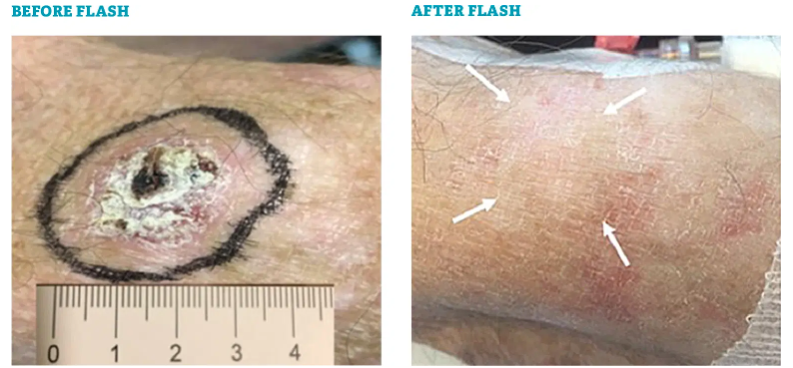
Treatment delivered 15 Gy with no unexpected side effects and complete tumor clearance.
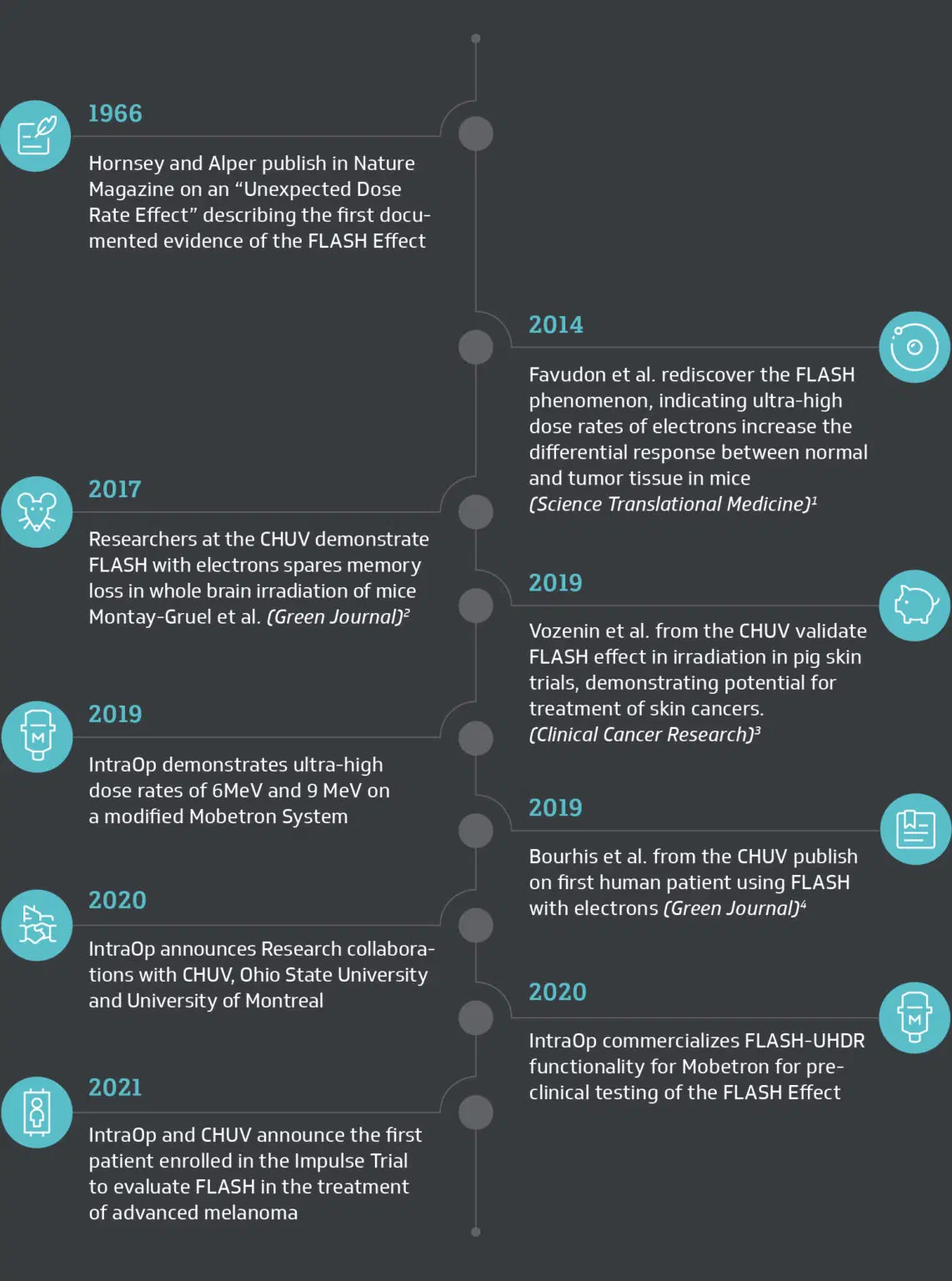
IntraOp is proud to be collaborating with leading researchers and institutions around the world to advance new technologies and research in FLASH therapy with a focus on translational studies to bring better care to patients safely and effectively.
The Impulse Trial is the first in a series of trials led by Principal Investigator Professor Jean Bourhis (CHUV, Switzerland) to study the FLASH effect in skin cancers. The first in the series is a phase I dose escalation study of ultra-high dose rate irradiation with electrons in patients with skin metastases from melanoma. This study is the first in the world to evaluate the potential of leveraging FLASH Effect to provide radiotherapy with curative intent to radio-resistant cancers.